
432 vs 440 Hz Calculator: What a 432 Hz Drum Means for Your Tuning
A 432 vs 440 Hz calculator for handpans, tongue drums and kalimbas: each note's frequency at both pitches, the 31.8 cent gap, and the nearest note to any frequency.
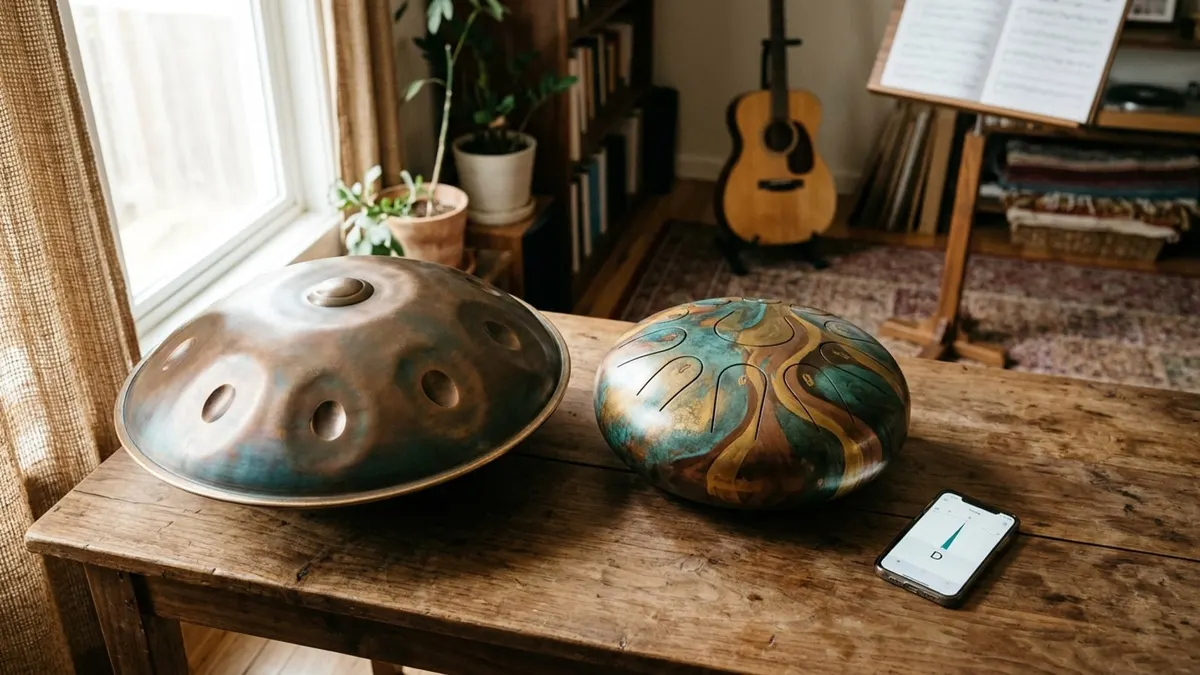
Affiliate disclosure: product links on this page go to Amazon or to the maker's own store. As an Amazon Associate we earn from qualifying purchases, at no extra cost to you; links to makers' own stores earn us nothing. No retailer or brand sees our picks before they are published or has any say in them. How we choose.
Many handpans, tongue drums and kalimbas are sold as tuned to 432 Hz. That number is the frequency of the note A above middle C, the reference every other note is tuned from. ISO 16 sets the standard at 440 Hz, and tuning instruments to within 0.5 Hz of it. This calculator shows what 432 means in practice: every note on the instrument, at both references, and how far apart they are.
Where does a 432 Hz note land against 440?
D3 on this instrument
144.16 Hz
A = 432 Hz
D3 at standard pitch
146.83 Hz
A = 440 Hz (ISO 16)
Offset from standard
-31.8 cents
a tuner at 440 reads it flat
Difference in hertz
2.67 Hz
440 version minus this one
Nearest note at A = 440
D3
146.83 Hz
How far off that note
-31.8 cents
flat
ISO 16 sets the standard A at 440 Hz. A drum built to 432 Hz has every note lower by the same ratio, about 31.8 cents (a cent is a hundredth of a semitone), so a chromatic tuner set to 440 reads each of its notes about a third of a semitone flat. That matters only when you play with fixed-pitch instruments tuned to 440; on its own the drum is in tune with itself. The second part turns a frequency from a listing or a tuner app into the nearest note at A = 440.
The short answer
A 432 Hz instrument is in tune with itself. Against instruments at the 440 standard, every note is lower by the same ratio, 432 divided by 440, which is about 31.8 cents, or roughly a third of a semitone (our arithmetic; a cent is a hundredth of a semitone). Played alone, that does not matter. Played with a piano, a guitar tuned to standard, or a recording, it sounds out of tune.
Some examples
| Note | At A = 440 Hz | At A = 432 Hz | Difference |
|---|---|---|---|
| A4 | 440.00 Hz | 432.00 Hz | 8.00 Hz |
| C4 | 261.63 Hz | 256.87 Hz | 4.76 Hz |
| D3 (D Kurd ding) | 146.83 Hz | 144.16 Hz | 2.67 Hz |
| D4 | 293.66 Hz | 288.33 Hz | 5.34 Hz |
The gap in hertz grows with pitch, but in cents it is always the same, about 31.8, because the ratio is fixed. ISO 16 asks tuning instruments to hold within 0.5 Hz of 440, far tighter than an 8 Hz gap.
Using the calculator
- Pick a note and octave on your instrument and its reference pitch, to see the frequency at both 432 and 440 and the offset in cents.
- Or enter a frequency from a listing or a tuner app to find the nearest note at A = 440 and how many cents off it is.
Tuning other instruments to a 432 Hz drum
A chromatic tuner set to 440 will read every note of a 432 Hz drum about 32 cents flat. To play along, set the tuner's reference to 432 and retune the guitar or other adjustable instrument to it (our reading). Fixed-pitch instruments such as a piano, a keyboard set to standard, or another 440 drum cannot follow, so for group playing a 440 instrument is simpler.
Why 432 shows up
Wikipedia's steel tongue drum article shows a drum tuned to a pentatonic F scale with A at 432 Hz, and many listings in our guides use it. Listings often attach health or relaxation claims to 432 Hz. We do not repeat them; what we can say is the arithmetic, and that ISO 16 has set 440 Hz as standard pitch since 1975 and confirmed it in 2022.
Which to buy
For playing alone, 432 or 440 both work. To play with others, choose 440: among our picks, the Sarospan handpan is built to 440 Hz. Kalimbas can be retuned, as Kalimba Magic explains, so a kalimba's reference is less of a commitment. See the handpan guide, the steel tongue drum guide and the kalimba tuning guide.
Frequently asked questions
What does 432 Hz mean on an instrument?
That its A above middle C is tuned to 432 Hz instead of the 440 Hz standard ISO 16 sets. Every other note is tuned from that reference.
How big is the difference between 432 and 440 Hz?
About 31.8 cents, or roughly a third of a semitone, on every note. In hertz it is 8 Hz at A4 and less on lower notes.
Can I play a 432 Hz handpan with a guitar?
Yes, if you retune the guitar with a tuner set to A = 432. A piano or other fixed instrument at 440 will sound out of tune with it.
Is 440 Hz the official standard?
Yes. ISO 16:1975 sets the note A in the treble stave at 440 Hz, and ISO confirmed the standard again in 2022.
Will my tuner work on a 432 Hz drum?
It will read every note about 32 cents flat at the default 440 setting. Many tuners let you change the reference to 432 so notes read as in tune.
Sources
- ISO 16:1975 Acoustics: Standard tuning frequency (Standard musical pitch), International Organization for Standardization
- Steel tongue drum, Wikipedia
- How to Tune the Kalimba, Kalimba Magic
Cover image: Illustration: Percussion Gear Review
Related guides

Best Drum Practice Pads (2026): Gum Rubber, Two-Sided and Tunable
Evans' RealFeel 12 inch pad is our pick: textured natural gum rubber for a realistic rebound, quiet on a table, a lap or in a snare stand, made in the USA.
Best Drumsticks for Beginners (2026): 5A Hickory, Maple and Kids' Sticks
Vic Firth's American Classic 5A is our pick: the 5A size most teachers start students on, in USA hickory with a teardrop tip and a lacquer finish.

Conga and Bongo Tuning Chart: Find the Note for Your Second Drum
Tune the high drum, read its note, and the chart gives the low drum's note and frequency: a fourth below for congas, an octave below for bongos.